Identity
Technical notes (click to open)(click to close)
Name & Human History
Etymology
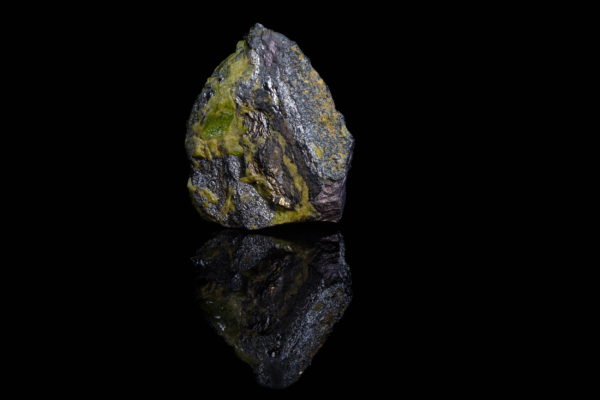
Titanite is a silicate of calcium and titanium, and one of the few minerals named for the metal it carries. Its crystals are famous for their shape: sharp wedges, often twinned, with a shine that runs from resinous to nearly adamantine. Colors range through brown, green, yellow, and black. Martin Klaproth named it in 1795 for the titanium he found inside it.
Today
Titanite is a collector's stone and a minor gem. Cut stones throw more fire than diamond, breaking light into flashes of spectral color, but the mineral is too soft and splits too easily for a ring. Geologists value it for another reason: it traps uranium as it grows, so a single crystal can be used to date the rock around it.
Geology & Occurrence
Formation
Titanite forms as a minor mineral in slowly cooling rocks rich in calcium. It is common in granites and syenites, scattered as small wedges among the feldspar. It also grows in metamorphic rocks, where heat and pressure rework limestone and volcanic rock into schist, gneiss, and marble. The largest, cleanest crystals come from open cracks, where there was room to grow.
Notable Localities
The classic crystals come from the Alps, from Switzerland and the Tyrol in Austria, where clean wedges sit in open clefts. Modern collectors look to Pakistan, whose Haramosh mountains have produced sharp green crystals. Good titanite also comes from Brazil, Madagascar, Italy, and from a number of sites in the northeastern United States and Canada.
This mineral has two names and a long argument behind them. Klaproth named it titanite in 1795 for its titanium. Six years later Rene Just Hauy called it sphene, from the Greek for wedge, after its shape, and that name won: for most of two centuries it was sphene. In 1982 the international body that governs mineral names discarded sphene and made titanite official. Jewelers ignored the ruling. Cut stones are still sold as sphene.