Identity
Technical notes (click to open)(click to close)
Name & Human History
Etymology
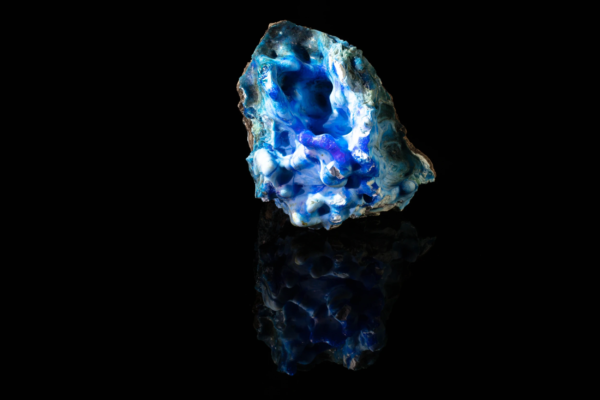
Woodwardite is a turquoise blue to greenish blue copper and aluminum sulfate that holds water. It forms crusts of tiny rounded balls and fibers rather than visible crystals. The chemist A. H. Church named it in 1866 for his friend Samuel Pickworth Woodward (1821-1865), an English geologist who studied fossil and living shells. Church's specimens came from a private collection in Cornwall, England. The exact mine that gave them is not known.
Today
Woodwardite has no practical use. It is a collector's mineral, looked for by those who collect the copper minerals formed by weathering. Its soft blue crusts look nearly opaque, but under a microscope the tiny balls are translucent.
Geology & Occurrence
Formation
Woodwardite forms in the weathered zone of copper deposits, near the surface where ore minerals break down. There, copper, aluminum, and sulfate in water come together and settle out as fibrous, rounded crusts. The minerals it usually grows with have not been well recorded.
Notable Localities
Cornwall, England, is the classic area, with the South Caradon mine at St. Cleer and the Botallack mine at St. Just among its sites. It is also reported from Klausen in the Tyrol, Italy. In the USA it comes from the Maid of Sunshine mine near Courtland, Arizona, and the Deer Trail mine near Marysvale, Utah. In Japan it is known from the Kabasaka and Nyukaku mines.
Woodwardite has long been a puzzle. When Church first described it, he noticed that it takes up water from the air, so its water content changed with the humidity. Its water content is still uncertain, and its formula is written with a range of 2 to 4 water molecules. Researchers published new data on it in 1940, 1976, and 1985. The species is still somewhat unclearly defined. So all of its reported localities may need checking again.