Identity
Technical notes (click to open)(click to close)
Name & Human History
Etymology
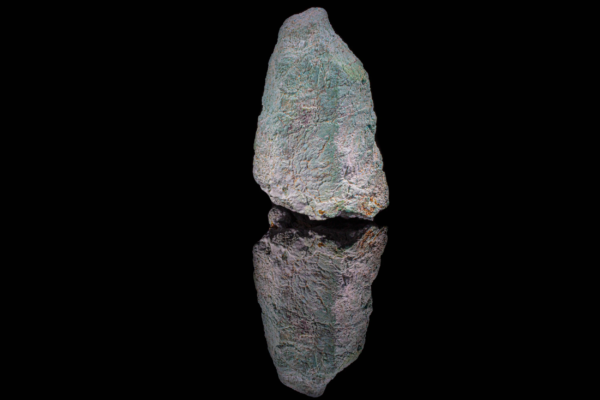
Turquoise is a phosphate of copper and aluminum that holds water. It is almost always found as dense, sky blue to blue green masses and veins, and very rarely as tiny crystals. Its name comes from the French word for Turkish. The stone came from Iran, but it reached Europe through Turkey, so Europeans named it after the land it passed through. The word has been in use since the 16th century.
Through the Ages
Turquoise was among the first gems ever mined. In Egypt it was used since at least the First Dynasty, about 3000 BCE. It was mined in the Sinai, at sites such as Serabit el-Khadim and Wadi Maghareh. The mines near Nishapur in Iran are just as old, and Persians covered palace domes with the blue stone. The Aztecs set it in mosaics on masks, knives, and shields, and peoples of the American Southwest mined it at Los Cerrillos, New Mexico. In the same region, at Pueblo Bonito in Chaco Canyon, a single room held more than 50,000 pieces, buried about a thousand years ago. In China it has been used since at least the Shang dynasty.
Today
Turquoise is still a popular gem, usually cut as rounded cabochons or beads. It is set in silver in Native American style jewelry and carved into small figures, such as Zuni fetishes. Much of the material sold is treated. Stones may be waxed, oiled, filled with epoxy, or backed with stronger material. Chalky powder can also be bonded into blocks. Dyed howlite and magnesite are the most common imitations today.
Geology & Occurrence
Formation
Turquoise forms near the surface, where rain water seeps down through copper deposits. The water picks up copper from weathering sulfide minerals. It then reacts with minerals in the host rock that carry aluminum and potassium. Turquoise forms most easily in dry climates. It makes small veins in altered volcanic rock or in sediments rich in phosphate. It is found with kaolinite, montmorillonite, allophane, wavellite, and pyrite.
Notable Localities
Iran is the classic source, near Neyshabur. The Sinai Peninsula of Egypt has been mined since ancient times. In the United States, Arizona is now the leading producer by value, and Nevada has more than 120 mines. China has been a source for 3,000 years or more, with gem nodules from Hubei Province. The rare single crystals come from the Bishop mine at Lynch Station, Virginia, found in 1912.
Turquoise may have been the first gemstone ever to be imitated. The ancient Egyptians made faience, a glazed ceramic, to copy its blue. Imitations have kept coming since. They range from aluminum phosphate colored with copper to Gilson turquoise, a copy introduced in 1972. Simple tests help. Under a lens, natural turquoise shows a pale blue background with whitish flecks. Dilute acid turns howlite green.
Much of what is sold as turquoise is, strictly speaking, not pure turquoise. In 1998 the turquoise group was redefined, and the name was kept for one exact makeup. The most common part of commercial turquoise is often planerite, a close relative. Turquoise also forms a full series with chalcosiderite, in which iron takes the place of aluminum.
Turquoise gave its name to a color, first recorded in English in 1573, but the stone itself was almost never used as paint. Ancient artists set it as stone, in beads, inlays and mosaics, and painted with other blues. Today a tube labeled cobalt turquoise holds oxides of cobalt and chromium, and no turquoise at all.