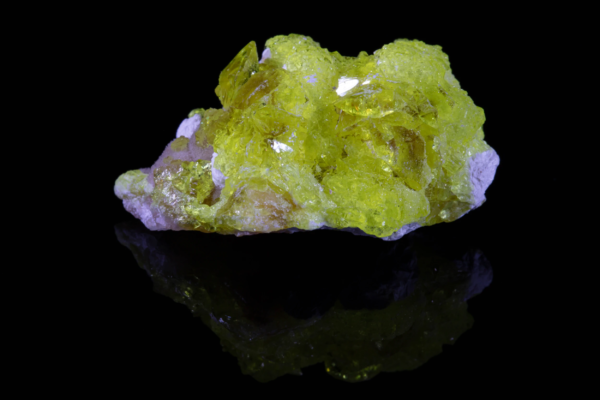
Identity
Technical notes (click to open)(click to close)
Name & Human History
Etymology
Xonotlite is a calcium silicate that almost never looks like a crystal. It grows as fine white needles, matted into felted masses, radiating bundles, and rosettes, and it is tough rather than brittle. Its shine is pearly to greasy. Karl Rammelsberg named it in 1866 for Tetela de Xonotla in Puebla, Mexico, where it was first found.
Today
Xonotlite is a curiosity in nature and a workhorse in industry. Natural specimens are wanted mostly as white sprays and mats, often as a backdrop for showier minerals. Meanwhile factories grow it on purpose, in vessels of hot lime and water, because the same interlocking needles that make it tough in a rock make excellent heat-resistant board.
Geology & Occurrence
Formation
Xonotlite forms where heat and hot fluids rework limestone. It grows in contact zones, the baked rock around an igneous intrusion, and in veins cutting serpentinite and altered volcanic rock. Calcium and silica meet in warm water and build long chains, which is why the mineral comes out as needles. It grows beside wollastonite, apophyllite, and other calcium silicates.
Notable Localities
Its type locality is Tetela de Xonotla in Puebla, Mexico. Fine material comes from the Wessels and N'Chwaning mines in the Kalahari manganese field of South Africa, where it forms white mats beneath rarer minerals. It also occurs at Crestmore in California, at Franklin in New Jersey, on Isle Royale in Michigan, and in Japan, Italy, Ireland, and Scotland.
Xonotlite was named in 1866 and then largely left alone. It had a name and a locality, but no proper description: nobody had pinned down what its structure actually was. That work waited until the 1950s, when the chemistry of calcium silicates suddenly mattered a great deal to the cement industry. The mineral was finally described in full ninety-three years after it was named.