Identity
Technical notes (click to open)(click to close)
Name & Human History
Etymology
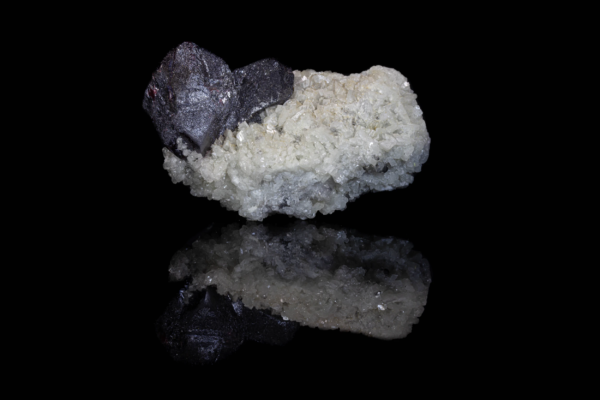
Cinnabar is mercury sulfide, a heavy red mineral that leaves a bright scarlet streak. It forms crystals, crusts, and grainy masses, from deep red to brownish red and lead gray. The Greek word kinnabari was used by Theophrastus, likely for several red substances. The name can be traced through Medieval Latin cinnabaris to a Persian word. That word seems to mean dragon's blood, a nod to its color.
Through the Ages
People used cinnabar as a color for thousands of years. In Spain, bones in the La Velilla dolmen, about 5,000 years old, were covered with the powdered mineral. In China it colored early stoneware and was used to write on oracle bones. Later it colored lacquerware. The Romans painted indoor walls with it and mined it for mercury. The mine at Almaden in Spain was worked from Roman times until 2001. Mining it was deadly work. Mercury poisoning caused shaking, loss of sense, and death among miners.
Today
Cinnabar is still the most common ore of mercury. The crushed ore is roasted in furnaces, and the mercury vapor is cooled back into liquid metal. It is the historic source of the red pigment vermilion. Jewelry makers now copy red lacquer with a resin instead. Collectors look for its bright red crystals, but it contains mercury and must be handled with care.
Geology & Occurrence
Formation
Cinnabar forms from warm water at fairly low temperatures. It fills veins and cracks in many kinds of rock. It is still forming today from the hot waters of Sulphur Bank in California and Steamboat Springs in Nevada. It grows with native mercury, stibnite, realgar, pyrite, opal, chalcedony, and calcite.
Notable Localities
Almaden in Spain is the best known historic cinnabar mine. Idrija in Slovenia is another historic mercury mine. Guizhou and Hunan provinces in China are also sources. In the USA, notable localities include New Almaden and New Idria in California and Terlingua in Texas.
At the Maya city of Palenque, a tomb from the 600s was found covered in cinnabar powder. It is known as the tomb of the Red Queen. Cinnabar was used across the ancient world for burials and color. Far to the south, two mummies from Cerro Esmeralda in Chile wore clothing dyed with it. They date to the 1400s. The bright red that honored the dead was also full of toxic mercury.