Identity
Technical notes (click to open)(click to close)
Name & Human History
Etymology
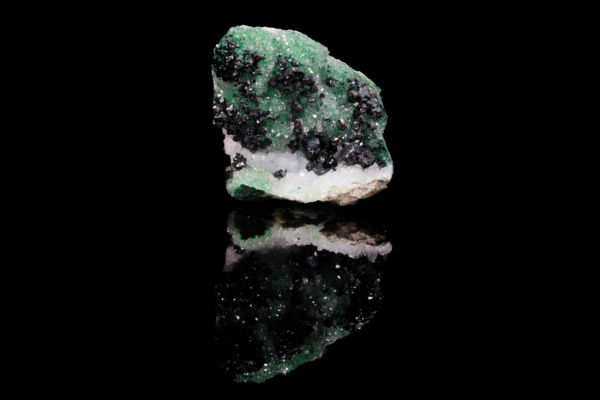
Clinoatacamite is a deep green copper mineral with a confusing past. It is a close relative of atacamite. The two share the exact same recipe of copper, chlorine, and water. The difference is hidden in the way their atoms are stacked. Where atacamite stacks them one way, clinoatacamite stacks them in a slightly tilted pattern. That tilt is captured in its name, since clino means leaning.
Today
Clinoatacamite was only named in 1996, which is recent for a mineral. For a long time, no one realized it was its own thing. It hid among specimens labeled as atacamite or paratacamite. The three look almost identical to the eye. Only careful study with X-rays revealed the difference. As a result, many old labels turned out to be wrong, and a lot of so called paratacamite is really this mineral.
Geology & Occurrence
Formation
Clinoatacamite forms the same way as atacamite. It grows near the surface, where copper ore meets salty water in dry places. The salt provides the chlorine, and the copper provides the green. The two combine into one of several closely related minerals. It often appears as small green crystals or crusts in the weathered tops of copper deposits.
Notable Localities
Because it was recognized so recently, the full list of localities is still being sorted out from old atacamite labels. The mineral is known from the copper districts of Chile, from old mines in Michigan, from Australia, and from Scotland. It usually turns up wherever copper deposits have weathered in a dry, salty setting.
Clinoatacamite is a good reminder that not every mineral can be known by sight. To the eye, it is simply a green copper mineral, easy to mistake for its cousins. Telling them apart truly takes a laboratory. Its naming in 1996 sent scientists back to old collections. There they found that many a labeled specimen was something other than its tag claimed.