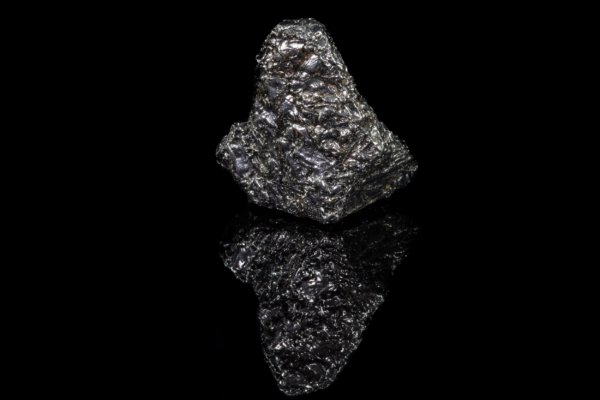
Identity
Technical notes (click to open)(click to close)
Name & Human History
Etymology
Kamacite is a metal, an alloy of iron and nickel, and on Earth it is found almost only in meteorites. It is the main metal in iron meteorites, the heavy lumps that fall from space. It is silvery, very dense, and strongly magnetic. The name was coined in 1861 from a Greek word for a pole or lath, after the long bands the metal forms.
Today
Kamacite is a piece of outer space you can hold. It makes up the bulk of most iron meteorites, the cores of shattered asteroids. Collectors prize polished and etched slices of these meteorites, where the metal shows a striking pattern. To hold one is to hold material older than the Earth's rocks, forged in the heart of a long dead asteroid.
Geology & Occurrence
Formation
Kamacite forms deep inside asteroids as their molten iron core cools. The cooling is almost unimaginably slow, a few degrees every million years. Over that vast time, kamacite slowly separates out from a second iron nickel metal called taenite. The two grow together in interlocking bands.
Notable Localities
Kamacite comes from iron meteorites found around the world. The Campo del Cielo meteorites of Argentina are a famous source, as is the Gibeon meteorite of Namibia, known for its fine pattern. Other classic iron meteorites turn up in many countries, the scattered remains of asteroids that struck the Earth long ago.
Kamacite reveals one of nature's most beautiful patterns. When an iron meteorite is cut, polished, and etched with acid, a crosshatch of fine bands appears, called the Widmanstatten pattern. It forms only over millions of years of slow cooling in space, and it cannot be copied in any laboratory. Finding that pattern is the surest proof that a lump of metal truly fell from the sky.