Identity
Technical notes (click to open)(click to close)
Name & Human History
Etymology
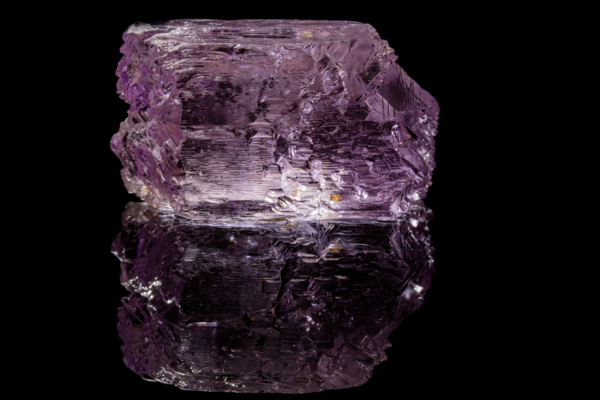
Kunzite is the lovely pink to lilac form of a mineral called spodumene. Pure spodumene is a dull gray lithium mineral, but a trace of manganese turns it a soft pink or violet. The more manganese, the deeper the color. It is named after George Kunz, a famous American gem expert, and it was first found in California in 1902.
Today
Kunzite is prized as a gem and as a collector crystal. It shows a lovely trick called pleochroism. Look down the length of the crystal and the pink is deepest, but look from the side and it fades almost to clear. Gem cutters use this to bring out the richest color. Some kunzite crystals are huge, and museums hold cut stones of hundreds of carats.
Geology & Occurrence
Formation
Kunzite forms in pegmatites, the coarse veins where slowly cooling magma grows large crystals of rare element minerals. There it sits among tourmaline, beryl, and lepidolite. Its parent, spodumene, is also a major ore of lithium, the light metal used in modern batteries, so these veins are mined for more than gems.
Notable Localities
Kunzite comes from a few famous pegmatite regions. The Pala district of California, where it was first found, is the historic home. Today much fine kunzite comes from Afghanistan, Brazil, Madagascar, and Pakistan. The Afghan crystals in particular can be large, clear, and richly colored.
Kunzite hides a delicate secret. Its pink color is not fully stable in light. Left in strong sunlight for a long time, a kunzite can slowly fade and lose its color. So a fine kunzite should be enjoyed but kept out of harsh light. Its parent spodumene has two gem siblings as well, green hiddenite and pale yellow triphane, each colored by a different trace metal.