Identity
Technical notes (click to open)(click to close)
Name & Human History
Etymology
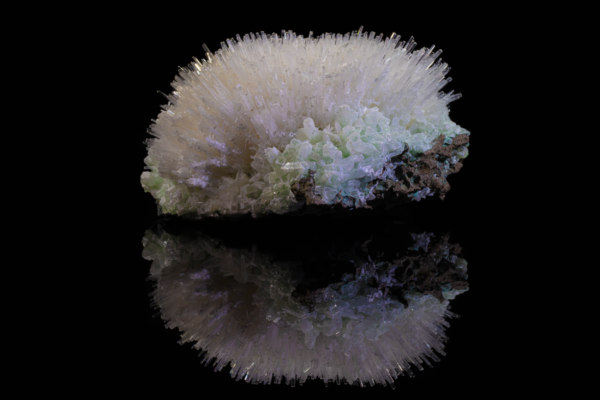
Mesolite is a delicate white zeolite, one of a family of light, water bearing silicates. It forms fine, hair like needles, often gathered into sprays, tufts, or fluffy looking balls. Its name comes from a Greek word for middle, because its makeup sits midway between two close relatives, natrolite and scolecite. The three are so alike they are hard to tell apart.
Today
Mesolite is mostly a collector's mineral, loved for its delicate crystal sprays. Bright white needle clusters, sometimes like tiny puffs of cotton, sit on dark rock and catch the light. But it is very fragile. The fine needles snap at a touch, so a mesolite specimen must be handled with real care and never brushed or wiped.
Geology & Occurrence
Formation
Mesolite forms in the gas pockets of old lava flows, the same setting that produces many zeolites. As mineral rich water moves through cooling basalt, it fills the empty bubbles with needle crystals. Mesolite grows there alongside other zeolites, as well as calcite and quartz. It also turns up in some veins.
Notable Localities
Mesolite comes from basalt regions around the world. The great lava flows of India, near Mumbai and Pune, have produced superb sprays and puff balls. Iceland and the Faroe Islands are classic sources, as is Scotland. Fine mesolite also comes from the basalts of Oregon and other parts of the United States.
Mesolite is the middle child of three look alike zeolites. Natrolite is the sodium rich one, scolecite the calcium rich one, and mesolite sits between them with a steady mix of both. All three grow as fine white needles and can be nearly impossible to tell apart by eye. A single crystal can even hold zones of more than one of them, which makes naming them a real puzzle.