Identity
Technical notes (click to open)(click to close)
Name & Human History
Etymology
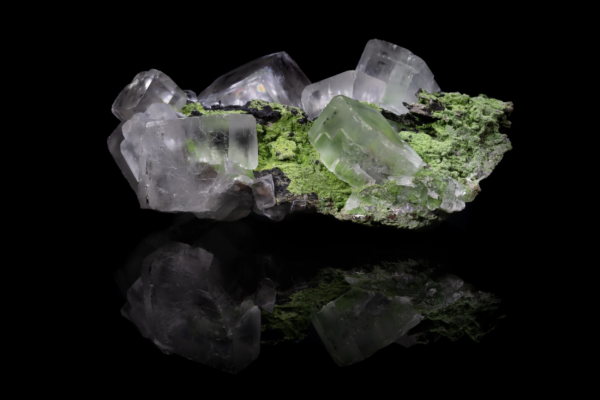
Mottramite is a green to olive or near black mineral, a vanadate of lead and copper. It usually forms as dark green crusts, rounded knobs, or small glittering druses on rock, with a greasy to glassy shine. It is named after Mottram, a place in England where the ore that yielded it was first studied. It is a minor ore of vanadium.
Today
Mottramite is mostly a collector's mineral. Its dark green to black crusts are not flashy, but they make a rich contrast against pale rock and pair well with brighter companions. It is one of the minerals that carry vanadium, a metal used to strengthen steel, though it is too scarce to be a major source of it.
Geology & Occurrence
Formation
Mottramite forms at the surface, in the weathered zone of metal deposits that hold lead, copper, and vanadium. As these elements are freed by weathering and meet again near the surface, they build mottramite as crusts and coatings. It grows there with other colorful secondary minerals such as vanadinite, mimetite, and cerussite.
Notable Localities
Mottramite comes from oxidized base metal deposits in several countries. The most famous specimens come from the Tsumeb mine and the wider Otavi region of Namibia, rich in lead and vanadium minerals. Good mottramite also turns up in the United States, in Mexico, and at its original English home.
Mottramite is one half of a mineral pair. It and a sister mineral, descloizite, form a smooth series. Where the metal alongside lead is copper, you get green mottramite, and where it is zinc, you get red brown descloizite. The two grade into each other, sharing the same form and setting, and differ mainly in that one trades copper for zinc.