Identity
Technical notes (click to open)(click to close)
Name & Human History
Etymology
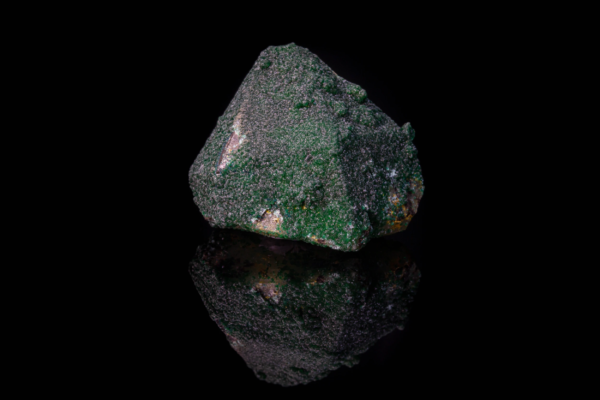
Philipsburgite is a rare green copper mineral. It is built from copper, zinc, arsenic, and phosphorus. It usually grows as tiny green crystals gathered into round, ball like clusters. It is named after the town of Philipsburg, in Montana, near the mine where it was first found. It is strictly a collector's mineral, of interest for its rarity and its tricky chemistry.
Today
Philipsburgite is one for the specialist collector. Its bright green spheres are small, often best seen under magnification, and good specimens are scarce. Because it holds arsenic, it is wise to wash hands after handling it and never to grind or breathe its dust. Its appeal is the thrill of owning a true rarity rather than any bold display.
Geology & Occurrence
Formation
Philipsburgite forms at the surface, in the weathered zone of copper deposits. Ores rich in copper, zinc, and arsenic slowly break down, and phosphorus is freed from other minerals. Then all four elements join to build it. It grows in cracks and cavities, alongside green copper minerals such as malachite and olivenite.
Notable Localities
Philipsburgite comes from a scattering of copper deposits around the world. The Black Pine mine, near Philipsburg in Montana, is its original home. It has also been found in Utah, in England, in the Czech lands, and in Japan. Everywhere it is a rare find, known mostly from small specimens.
Philipsburgite belongs to a trio of closely related minerals, and the three are easy to mix up. It sits in the middle, with arsenic and phosphorus in a tidy, ordered balance. Its cousins are kipushite, which leans to phosphorus, and goldhillite, which is all arsenic. Many specimens labeled philipsburgite are really goldhillite, so the name should rest on a true analysis, not on color alone.