Identity
Technical notes (click to open)(click to close)
Name & Human History
Etymology
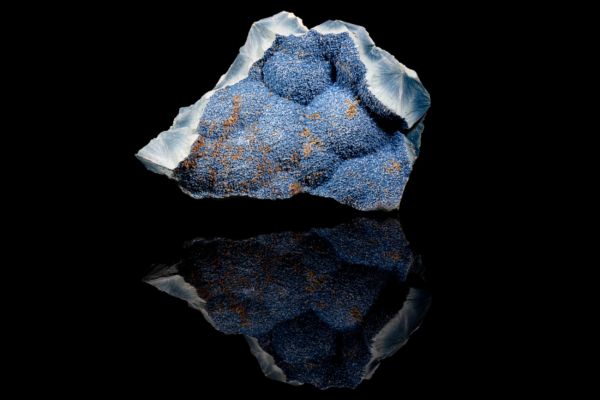
Shattuckite is a rare copper mineral of a deep, rich blue. It is a copper silicate, and its blue comes from the copper in its makeup. It usually grows as tiny needle crystals gathered into radiating sprays, blue balls, and velvety crusts. It is named after the Shattuck mine in Bisbee, Arizona, where it was first found in 1915.
Today
Shattuckite is prized by collectors for its intense blue color. Good pieces are sprays of deep blue needles or rounded blue balls on rock. When it grows solid, it is cut and polished into beads and ornamental stones. It is too rare to be an ore, so its whole value lies in its beauty and its scarcity.
Geology & Occurrence
Formation
Shattuckite forms at the surface, in the weathered zone of copper deposits. It grows as a late mineral, often by slowly replacing earlier copper minerals. In a striking trick of nature it can take over a crystal of malachite or dioptase atom by atom. It keeps the old shape while changing the substance, a process called pseudomorphism.
Notable Localities
Shattuckite comes from only a few places. The Shattuck mine in Bisbee, Arizona, is its original home. By far the finest specimens today come from Namibia, in the Kaokoveld region. There it forms gorgeous deep blue sprays and spheres. It is also found in the copper deposits of the Congo, often with green dioptase.
Shattuckite is one of nature's best blues, and it has a near twin. A similar blue copper silicate called plancheite shares its color, its habit, and even its haunts. The two are easily confused. They can grow together in the same specimen, and telling them apart often takes more than the eye.