Identity
Technical notes (click to open)(click to close)
Name & Human History
Etymology
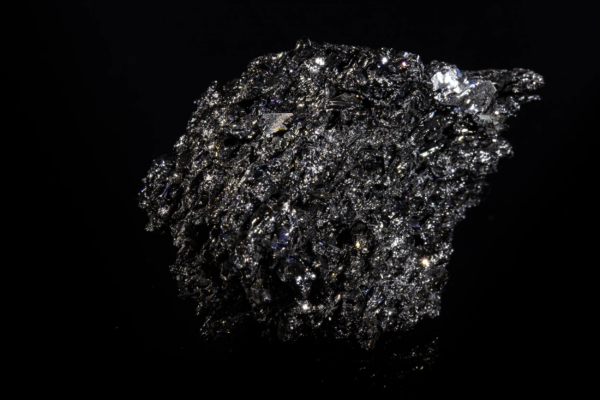
Specularite is a sparkling, mirror bright form of hematite, the common iron oxide. Its name comes from the Latin word for mirror, after the way its surface shines like polished metal. It is silvery gray to black. It glitters because it is made of countless tiny plates or grains that catch the light. The same iron oxide also sits in this collection as ordinary hematite.
Today
Specularite is loved for its shine. A slab of it sparkles all over as if dusted with metal flakes. It has long been used as an ornamental stone and, ground up, as a glittering pigment. Some pieces hold their sparkling flakes inside clear quartz, giving the stone a shimmer that jewelers prize.
Geology & Occurrence
Formation
Specularite forms where iron rich fluids deposit hematite in thin, shiny plates. It grows in veins, in metamorphic rocks, and around old volcanic vents. The platy habit is simply hematite that grew in flat, flaky crystals rather than solid masses. That is what gives specularite its mirror like glitter.
Notable Localities
Specularite is found in many iron districts around the world. Fine flaky specularite comes from Brazil, from the Alps of Switzerland and Italy, and from the iron ranges of the United States. Sparkling specimens turn up wherever hematite has grown in flat, bright plates.
Specularite is hematite wearing its finest clothes. Both are the same iron oxide, with the same deep red streak, but specularite grew as a mass of tiny mirrors. Rubbed on rough tile, even this glittering silver stone leaves a rust red mark. That is the sure sign that, for all its shine, it is simply hematite at heart.