Identity
Technical notes (click to open)(click to close)
Name & Human History
Etymology
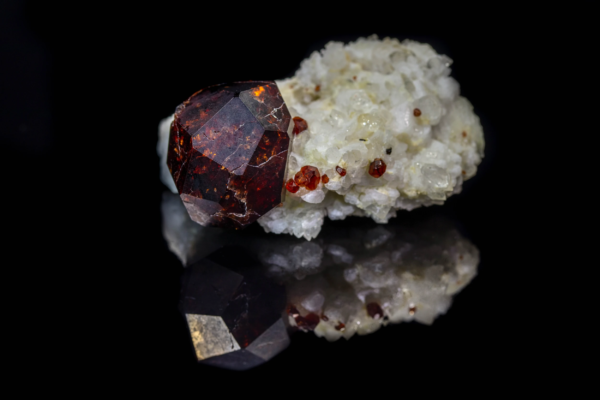
Spessartine is the manganese garnet, one of the deep red to orange members of the garnet family. It forms the classic garnet shape, many sided crystals with a glassy shine, in colors from honey yellow through fiery orange to red. It was named in 1832 for the Spessart, a range of hills in Bavaria, Germany, where it was first found.
Today
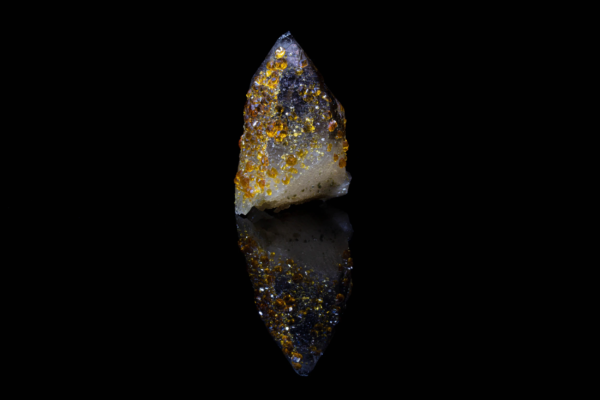
Spessartine is prized for a single electric color: a pure, glowing orange the gem trade calls mandarin garnet. Clear stones are cut as gems, and fine crystals are collector treasures, above all the sharp orange garnets that sit on white feldspar and smoky quartz. Its color, like that of many orange and pink minerals, comes from manganese.
Geology & Occurrence
Formation
Spessartine grows in granite pegmatites, in certain volcanic rocks, and in manganese rich metamorphic rocks. It appears where manganese and aluminum meet in the right hot conditions. Like all garnets it is tough and resists weathering, so its crystals often survive to gather in stream gravels after their host rock wears away.
Notable Localities
The mineral takes its name from the Spessart hills of Bavaria. Its most spectacular crystals today come from Tongbei in Fujian, China, where bright orange garnets perch on white feldspar. Fine gem material comes from Nigeria and Namibia, sold as mandarin garnet, and from Brazil, Madagascar, and Pakistan.
Spessartine spends its life being called by the wrong name. It is constantly written and sold as spessartite, but spessartite is something else entirely, a type of dark volcanic rock. The garnet is spessartine, ending in ine, one of the most misspelled names in all of mineralogy, muddled even in gem shops and catalogs.