Identity
Technical notes (click to open)(click to close)
Name & Human History
Etymology
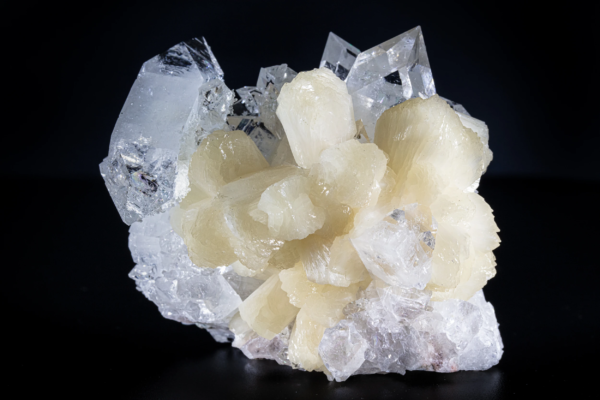
Stilbite is a graceful zeolite, a light, water bearing silicate, usually white, peach, or salmon pink. Its name comes from a Greek word for shine, after the pearly luster of its surfaces. Its most charming feature is its shape. The crystals grow together in sheaves and bundles, often pinched in the middle like a tied bow or a bundle of wheat.
Today
Stilbite is a favorite of collectors for its warm color and elegant form. Peach and salmon colored sheaves of stilbite, often on a bed of other zeolites, make some of the most popular zeolite specimens of all. It has no industrial use to speak of, but few minerals are so pleasing to the eye, which is reason enough to prize it.
Geology & Occurrence
Formation
Stilbite forms in the gas pockets of old lava flows, the home of many zeolites. As mineral rich water moves through cooling basalt, it fills the empty bubbles with crystals. Stilbite grows there alongside other zeolites, as well as calcite and quartz. It also turns up in the cavities of granite and in hot spring deposits.
Notable Localities
Stilbite is found in basalt regions around the world. The great lava flows of India, near Mumbai and Pune, are famous for superb peach colored sheaves. Iceland, Scotland, and the Bay of Fundy in Nova Scotia are classic sources. Fine stilbite also comes from Brazil and the United States.
Stilbite is known by its bow tie shape above all. The crystals fan out from a narrow waist into two flaring ends, like a bundle of straw tied in the middle, or a bow tie. This habit is so distinctive that a collector can often name stilbite at a glance. The full name stilbite-Ca marks the common, calcium rich kind of this lovely zeolite.