Identity
Technical notes (click to open)(click to close)
Name & Human History
Etymology
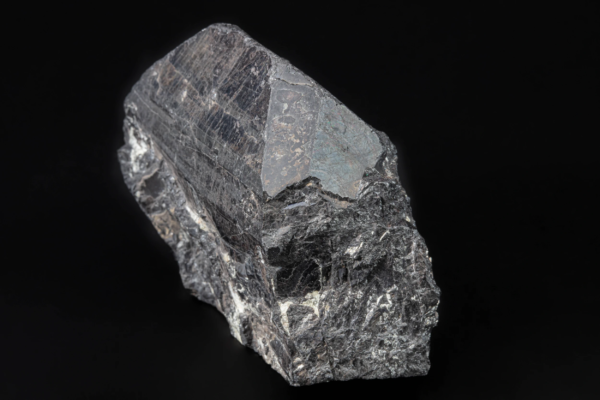
Wolframite is a heavy, brownish black mineral, the chief ore of the metal tungsten. It is so dense that it feels surprisingly weighty for its size, a useful clue to spotting it. It forms dark, bladed crystals with a dull metallic sheen. Wolframite is not really one mineral but a blend of two, mixed in every proportion.
Today
Wolframite is mined the world over for tungsten, one of the toughest of metals. Tungsten goes into hard steels, into the cutting tips of drills and tools, and once into the glowing filaments of light bulbs. For collectors, sharp bladed black crystals on white quartz make a handsome and weighty specimen.
Geology & Occurrence
Formation
Wolframite forms at high temperatures, deep underground. It grows in veins of quartz around granites, laid down by very hot fluids, and in coarse veins called pegmatites. It often keeps company with the tin ore cassiterite, so tin and tungsten are frequently mined from the same ground.
Notable Localities
Wolframite is found in many tungsten districts. China is by far the largest source, especially the mines of Hunan. Superb crystals come from Panasqueira in Portugal. Good wolframite also comes from Bolivia, England, and Colorado, usually in veins of milky quartz.
Wolframite got its odd name from frustrated tin smelters long ago. German miners found that this dark mineral, mixed in with their tin ore, spoiled the smelting and ate away the precious tin. They said it devoured the tin like a wolf devours a sheep, and called it wolf's cream. From that, tungsten took its chemical symbol, the letter W. It sits between two end members, one of which, hubnerite, is also held in this collection.