Identity
Technical notes (click to open)(click to close)
Name & Human History
Etymology
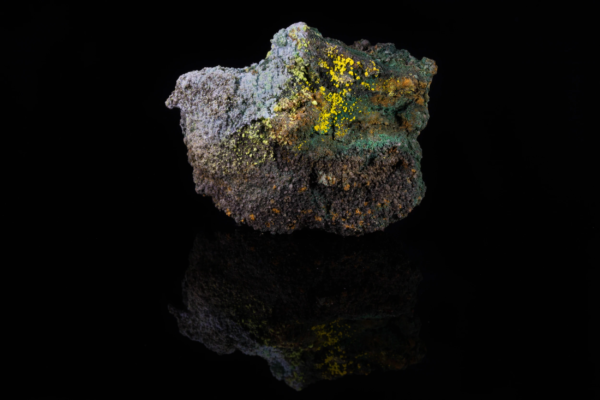
Zippeite is a yellow to orange uranium mineral. It is a sulfate of potassium and uranium that holds water. It forms powdery coatings, crusts, and very small crystals. It is named for Franz Xaver Maximilian Zippe (1791-1863), an Austrian mineralogist. Wilhelm Haidinger gave it the name in 1845. The first material came from Jachymov, once called Joachimsthal, in the Czech Republic.
Today
Zippeite has no practical use today. Collectors of uranium minerals look for it because it glows bright yellow under ultraviolet light. Its colors run from deep yellow to orange red. It is radioactive. So specimens should be stored with care and handled as little as possible.
Geology & Occurrence
Formation
Zippeite is a secondary mineral. It forms in weathered uranium deposits that also contain sulfides. Some zippeite even forms on mine walls after mining has opened the rock. It is found with uranopilite, johannite, uranophane, schrockingerite, gypsum, and other members of the zippeite group.
Notable Localities
The classic locality is Jachymov in the Czech Republic. It is also found at Nowa Ruda in Lower Silesia, Poland. Several Cornish mines in England have it, such as South Terras and Wheal Owles. In the United States it occurs in Colorado, at the Apex mine in Nevada, and in Arizona.
Zippeite was studied long before it had a name. In 1821 a scientist named John described a yellow earthy uranium sulfate from Joachimsthal. In 1845 Haidinger gave that material the name zippeite. In the 1850s Adolf Patera noticed the bright yellow powders on the mine dumps there and used them to make paints. In 1976 zippeite became the potassium member of a whole group, with sodium, cobalt, nickel, magnesium, and zinc versions. A 2003 study of its crystal structure gave it a new formula.