Identity
Technical notes (click to open)(click to close)
Name & Human History
Etymology
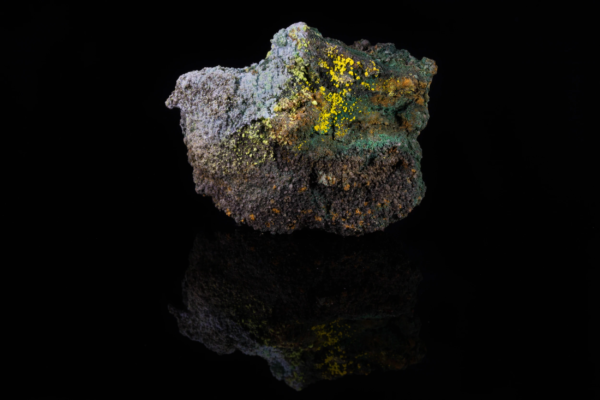
Johannite is a green uranium mineral that also holds copper and sulfate. It forms small glassy crystals, flaky scales, and thin crusts. Its color runs from emerald green to yellowish green. Wilhelm Haidinger first described it in 1830. He named it after Archduke Johann of Austria (1782-1859), who founded the Landesmuseum in Graz. The type locality is the Elias mine at Jachymov, in the Czech Republic.
Today
Johannite has no industrial use. Collectors of uranium minerals look for it. It is radioactive, so specimens need careful storage and handling. It also breaks down in water, which makes it a fragile mineral to keep.
Geology & Occurrence
Formation
Johannite is a secondary mineral. It forms when uraninite and other uranium minerals oxidize in deposits that also hold sulfides. It often forms after mining has opened the rock to air and water. It can grow as thin crusts. Typical companions are gypsum, zippeite, uranopilite, brochantite, and chalcanthite.
Notable Localities
The first specimens came from Jachymov in the Czech Republic. The mineral is also known from Germany, France, Italy, and Cornwall in England. In the United States it comes from several uranium districts. These are in Colorado, Utah, Arizona, and California. Other finds come from Gabon, Tajikistan, and Great Bear Lake in Canada.
Many johannite crystals are younger than the mines they grow in. It is often described as forming after mining began. When miners cut tunnels through uranium ore rich in sulfides, air and water reach the rock and the ore starts to weather. Johannite is one of the minerals that grow from this weathering. For this reason it is listed among minerals that form in mines because of human activity.