Identity
Technical notes (click to open)(click to close)
Name & Human History
Etymology
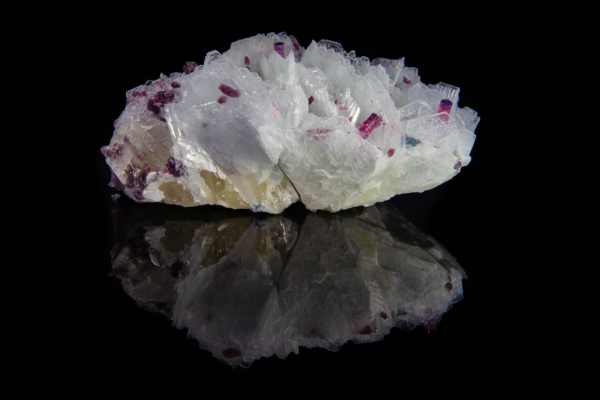
Cleavelandite is not a mineral of its own but a special form of albite, one of the most common feldspars. What sets it apart is its shape. It grows as thin, flat blades that fan out in curved sheets. They often pile up like the petals of a cabbage. It was named in 1823 for Parker Cleaveland, an American professor who wrote the first mineralogy textbook in the United States.
Today
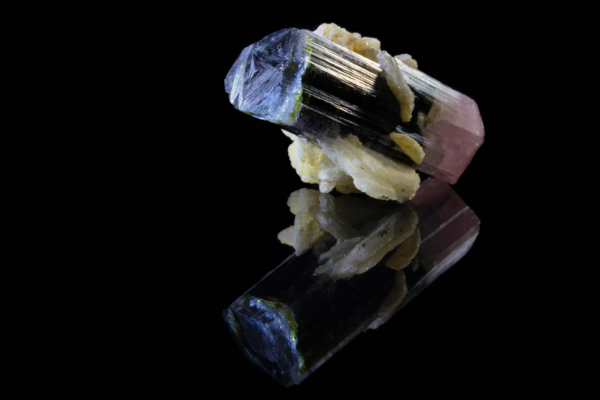
Cleavelandite is mostly a backdrop mineral, but a beautiful one. Its bright white, bladed crusts line the pockets of certain rocks. They make a clean stage for showier crystals to sit on. Collectors prize specimens where colorful gems perch on a bed of white cleavelandite blades. On its own it is admired for the way its thin, curved plates catch the light.
Geology & Occurrence
Formation
Cleavelandite forms in pegmatites, the coarse veins where slow cooling lets crystals grow large. It is one of the last minerals to crystallize there. It often lines open pockets late in the process. Because of this, it frequently grows alongside gem minerals like tourmaline and beryl, and the lithium minerals lepidolite and spodumene. Its bladed crusts can coat a whole pocket wall.
Notable Localities
Cleavelandite is found in pegmatites all over the world. The famous gem pegmatites of San Diego County, in California, produce fine cauliflower like groups of it. Excellent cleavelandite also comes from Brazil, from the pegmatites of Afghanistan and Pakistan, and from Maine, often with tourmaline.
Cleavelandite honors a quiet giant of early American science. Parker Cleaveland taught at Bowdoin College in Maine. In 1816 he wrote the first real American textbook on minerals. His book helped launch the study of minerals in the young United States. When a fellow scientist found a striking new form of albite, he named it cleavelandite in Cleaveland's honor.