Identity
Technical notes (click to open)(click to close)
Name & Human History
Etymology
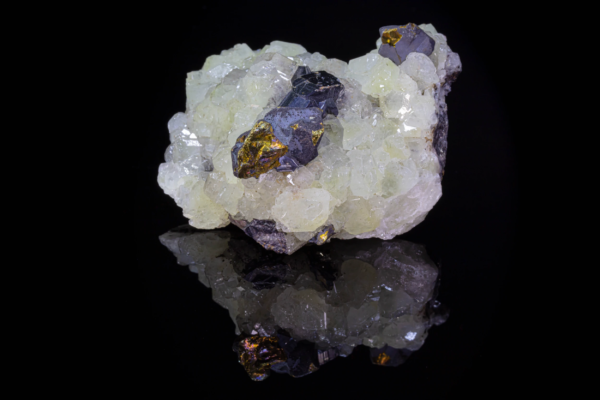
Datolite is a glassy mineral, usually colorless or a soft pale green, with a name that points to a quirk. It comes from a Greek word meaning to divide. When datolite grows in granular masses, those masses crumble and divide apart very easily. A Norwegian professor gave it the name in 1806, after studying the first crumbly specimens. Despite that fragile name, datolite also forms lovely, sharp, glassy crystals.
Today
Datolite is mainly a collector's mineral, but one part of the world has made it famous. In the copper country of Michigan, datolite grows not as crystals but as smooth, rounded nodules that look like fine porcelain. These come in soft creams, pinks, and reds. The prettiest are dotted with tiny flecks of native copper. Cut and polished, they make a uniquely American ornamental stone.
Geology & Occurrence
Formation
Datolite forms in the gas pockets of old lava flows. As mineral rich water moves through cooling basalt, it fills the empty bubbles with crystals, and datolite is one of them. It grows there beside zeolites, prehnite, calcite, and quartz, the usual company of basalt cavities. In Michigan it forms instead within the rocks of the great copper deposits.
Notable Localities
Fine datolite crystals come from a number of places around the world. The mines of Dal'negorsk in eastern Russia produce large, clear, glassy crystals that collectors prize. The copper district of Michigan is the home of the porcelain nodules. Good crystals also come from Norway, where the mineral was first found, and from New Jersey and Italy.
Michigan's porcelain datolite is a small marvel. Over millions of years, datolite filled cavities in the copper bearing rocks, picking up traces of copper and other metals as it grew. Those traces tint the nodules in soft shades and dot them with sparks of red copper. No two are alike, and a polished slice can look like a tiny painting in stone.