Identity
Technical notes (click to open)(click to close)
Name & Human History
Etymology
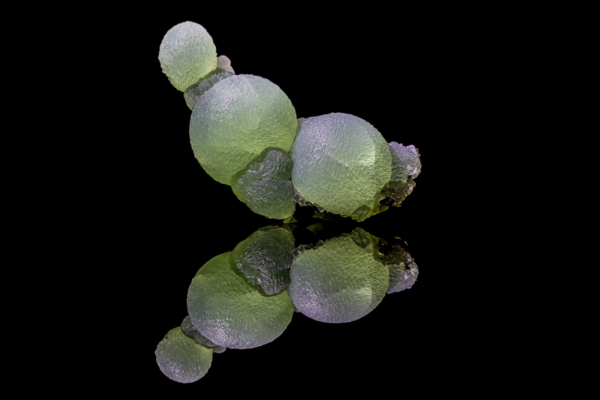
Prehnite is a soft green to yellow green mineral with a gentle, glowing look. It is a silicate of calcium and aluminum, and its trace of iron gives it that apple green color. It rarely forms sharp crystals. Instead it grows as smooth, rounded, grape like masses, or as crusts whose surface is a field of tiny curved crystal tips.
Today
Prehnite is a favorite of collectors and is also cut as a gem. Its translucent green seems to glow softly from within, and good pieces are carved into beads and cabochons. Some fibrous pieces show a moving line of light, a cat's eye effect. A classic specimen is a green prehnite dome studded with dark needles of epidote.
Geology & Occurrence
Formation
Prehnite forms early in the gas pockets of cooling lava. It is often the very first mineral to line a fresh cavity, arriving before the zeolites, calcite, and quartz that fill in later. It also grows in veins and in low grade metamorphic rocks. Geologists even name a stage of mild metamorphism after it.
Notable Localities
Prehnite is found around the world. South Africa, where it was first discovered, remains a classic source. Today some of the finest gem green balls come from Mali, often perched on dark epidote. Fine prehnite also comes from Australia, China, Scotland, and the northeastern United States.
Prehnite holds a special place in history, for it was the first mineral ever named after a person. A Dutch colonel, Hendrik von Prehn, collected it at the Cape of Good Hope in South Africa and carried it back to Europe in the late 1700s. A German scientist named the green stone in his honor. That simple act began a custom now followed for hundreds of minerals.