Identity
Technical notes (click to open)(click to close)
Name & Human History
Etymology
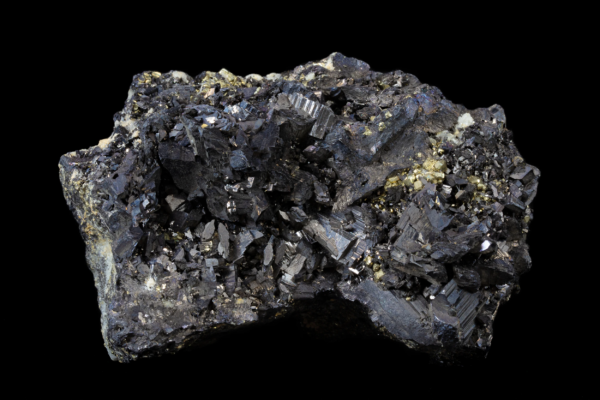
Enargite is a dark, metallic mineral built from copper, arsenic, and sulfur. It forms hard, glittering crystals in shades of steel gray to violet black. Its name comes from a Greek word meaning distinct, a nod to the clean way it splits along one direction. It is an important ore of copper. But the arsenic locked inside it makes that copper tricky and costly to refine.
Today
Enargite is valued in two very different ways. To industry it is a copper ore, often carrying useful gold and silver as well. To collectors it is prized for its sharp, gleaming crystals. They rise as slender prisms from white quartz or golden pyrite. It is not a colorful mineral, but a fine cluster has a bold, dramatic look that many collectors love.
Geology & Occurrence
Formation
Enargite forms in hot mineral veins, dropped by heated fluids passing through rock at medium to low heat. It grows there with quartz, pyrite, and a crowd of other copper and sulfur minerals. It is a key sign of a certain kind of hot, acidic ore system, so geologists take note when they find it. It often forms slender prisms with finely grooved faces.
Notable Localities
The most famous enargite came from the great copper mines of Butte, Montana, known for splendid crystals. Peru is another classic source, especially the Quiruvilca mine, which yields bright, slender prisms on white quartz. Fine enargite also comes from the Philippines, from Serbia, and from copper deposits across the Americas. It was first described from a mine in Peru.
Enargite has a near twin that shares its exact recipe. The mineral luzonite is made of the same three elements, but its atoms are stacked in a different pattern, so it forms different crystals. The two are so alike that telling them apart can be hard. One thing to remember is that enargite holds arsenic. It is wise to wash hands after handling it and to keep it away from food.