Identity
Technical notes (click to open)(click to close)
Name & Human History
Etymology
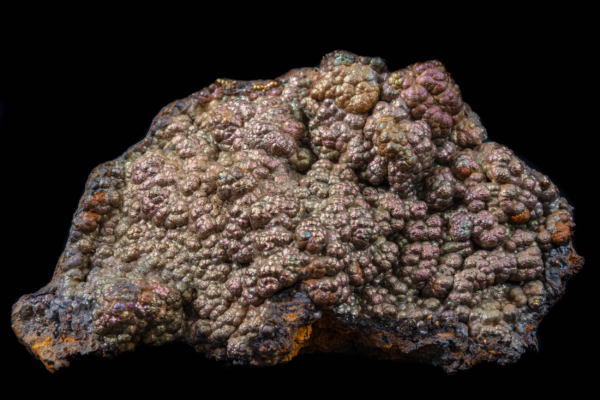
Limonite is not really one mineral but a name for a whole family of rusty iron stuff. It is a mix of iron, oxygen, and water, in shades of yellow, brown, and ochre. Most of it is really the mineral goethite, blended with bits of others and with no fixed recipe. The name comes from a Greek word for meadow, because it gathers in bogs and wet, low lying ground.
Today
Limonite has served people since the dawn of metalworking. The soft brown ore that forms in swamps, called bog iron, was one of the first sources of iron, smelted thousands of years ago. Ground to a powder, limonite makes yellow and brown ochre, among the oldest paints known. Roasted in a fire, it turns red, giving the warm tones of sienna and umber.
Geology & Occurrence
Formation
Limonite forms at the surface, as iron minerals weather and break down. When pyrite, magnetite, or other iron minerals meet air and water, they slowly rust into limonite. It builds the rusty cap, called gossan, that sits over many ore deposits. It also settles in bogs and lakes, and it stains countless rocks and soils brown.
Notable Localities
Limonite is found almost everywhere there is iron, which is to say nearly everywhere. It forms the brown crust on weathered rocks the world over. Notable bog iron deposits occur across northern Europe and North America. As a rusty coating and a soft brown ore, limonite is one of the most common iron bearing materials on Earth.
Limonite is best understood as nature's rust. Because it is a mixture with no fixed makeup, it is not counted as a true mineral but as a mineraloid, a mineral like substance. Much of it is really goethite in disguise. One of its charms for collectors is the way it copies other minerals. Iron rich water can replace a crystal of pyrite atom by atom, leaving a limonite cast in the exact shape of the original.