Identity
Technical notes (click to open)(click to close)
Name & Human History
Etymology
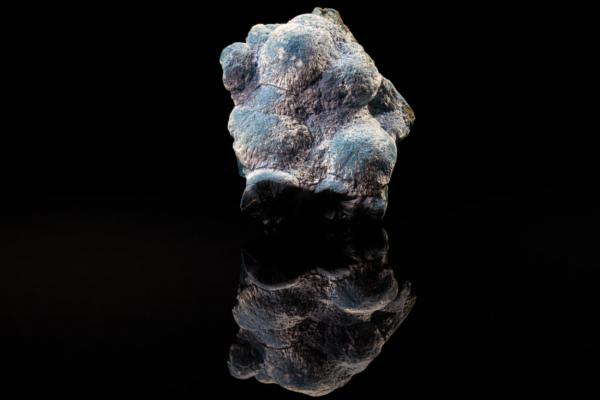
Plancheite is a blue silicate of copper, a secondary mineral born where copper ore weathers. It forms sprays of fine needles and fibers, matted into velvety crusts and rounded balls, in shades from pale sky blue to deep blue green. It was described in 1908 from specimens found in the Congo.
Today
Plancheite is a collector's copper mineral, wanted for its rich blue and its silky, fibrous sprays. Solid masses are sometimes cut and polished. It has no use beyond the specimen and the ornament, and the finest material comes from just a few African copper districts.
Geology & Occurrence
Formation
Plancheite forms at the surface, in the weathered, oxidized cap of copper deposits. There, copper freed by weathering combines with silica in cool water and crystallizes as fine blue fibers. It grows alongside other bright secondary copper minerals such as dioptase, malachite, and shattuckite.
Notable Localities
Plancheite comes mainly from the great copper belt of central Africa, from the Katanga region of the Democratic Republic of the Congo and from the Kaokoveld of Namibia. It is also found in Arizona. Its finest deep blue material is closely tied to these African deposits.
Plancheite came to science riding alongside a more famous mineral. The French mineralogist who described it in 1908 was studying a celebrated Congo find rich in dioptase, the brilliant green copper gem, and among those specimens he picked out a new blue fibrous mineral that no one had named. It has been bound to the copper deposits of central Africa ever since.