Identity
Technical notes (click to open)(click to close)
Name & Human History
Etymology
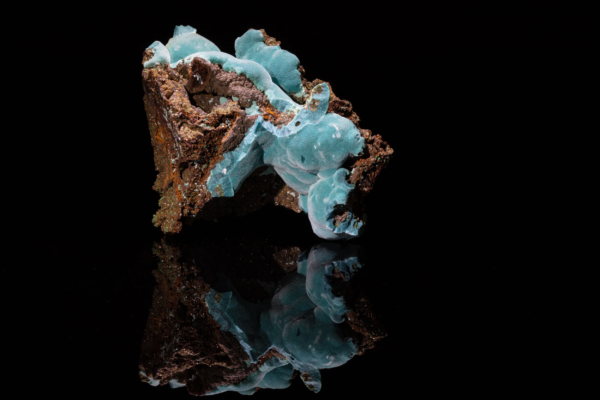
Rosasite is a lovely blue green mineral, a carbonate of copper and zinc. Its soft sky blue to green color is its main charm. It usually grows as tiny fibrous crystals gathered into little balls and velvety crusts. It is named after the Rosas mine in Sardinia, where it was first found in the early twentieth century.
Today
Rosasite is strictly a collector's mineral. It is too soft and too scarce for any other use. But its blue green spheres are a delight. They often sit on a bed of red brown limonite, or beside other bright copper minerals. The result is a colorful and prized small specimen, sought by those who collect copper minerals.
Geology & Occurrence
Formation
Rosasite forms at the surface, in the weathered zone of copper and zinc deposits. Zinc rich waters wash over copper minerals, and the two metals join with carbonate to build it. It grows in cracks and cavities. Its companions there are other secondary minerals such as malachite, smithsonite, and aurichalcite.
Notable Localities
Rosasite comes from oxidized copper zinc deposits around the world. The Ojuela mine at Mapimi, in Mexico, is famous for fine pieces. The Rosas mine in Sardinia is its original home. The great Tsumeb mine in Namibia has produced superb examples, and good material also comes from Arizona and New Mexico.
Rosasite is a close relative of malachite, the common green copper carbonate. In it, some of the copper is replaced by zinc, which shifts the color toward blue. The two can grade into one another, and a blue green crust may be either one. Telling the two apart can take a laboratory, so the name should rest on more than color alone.