Identity
Technical notes (click to open)(click to close)
Name & Human History
Etymology
Rubellite is the name for pink to red tourmaline. It is not a separate mineral but a color variety, most often of elbaite, the lithium-rich gem tourmaline. The name comes from the Latin rubellus, meaning reddish, and was first used in 1794. Its warm color comes mainly from manganese held in the crystal.
Through the Ages
For centuries, red tourmaline passed for ruby. Before modern testing, red stones were sorted by color alone. The most famous case is a raspberry-shaped stone of about 255 carats called Caesar's Ruby. Recorded since the late 1500s, it was given to Catherine the Great of Russia in 1777. Only in 1922, during an inventory of the Russian crown jewels, did the mineralogist Alexander Fersman show that it was rubellite.
Today
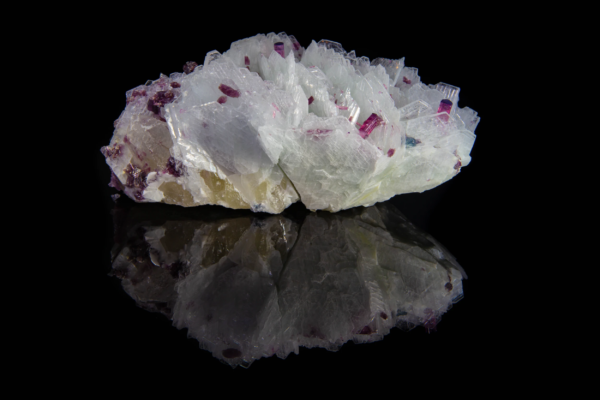
Rubellite is one of the most valued tourmalines. The finest stones are a pure red with no brown. The trade still argues over whether pale pink stones deserve the name at all. Collectors prize sharp red crystals on white bladed albite or beside purple lepidolite, the classic look of a gem pocket.
Geology & Occurrence
Formation
Rubellite grows in granite pegmatites rich in lithium. These are coarse veins where the last fluids of a cooling granite crystallize, rich in rare elements such as lithium and boron. Manganese in those fluids gives the crystals their pink to red color, and open pockets in the pegmatite give them room to grow long and clear.
Notable Localities
Brazil is the leading source. Its best crystals come from the pegmatites of Minas Gerais, at mines such as Cruzeiro and Pederneira. Rubellite is also found in Nigeria, Madagascar, Afghanistan, Myanmar, and Russia. In the United States, the old pegmatite mines of San Diego County in California are a famous source.
A label that says rubellite tells you the color, not the exact mineral. Most rubellite is elbaite or its cousin fluor-elbaite. Some pink tourmaline turns out to be olenite or liddicoatite instead. They look the same in the hand. Only a chemical test can tell which one a crystal really is.