Identity
Technical notes (click to open)(click to close)
Name & Human History
Etymology
Lepidolite is a mica that holds lithium. It is often pink to purple and splits into thin sheets. Its name comes from the Greek word for scale, after its scaly, flaky look. Martin Heinrich Klaproth described it in 1792, and specimens with his labels are kept in Berlin. The type locality is Rozna, near Brno in the Czech Republic. Under the modern rules for naming micas, lepidolite is a series name, not a single species. It covers the micas between trilithionite and polylithionite.
Through the Ages
Lepidolite went from a curiosity to an ore at Pala, in southern California. The first prospector to work the outcrop, Henry Magee, saw red tourmaline in pink mica and took the ore for cinnabar, the red ore of mercury. From 1892 to 1907 the American Lithia and Chemical Company mined the lilac mica there for lithium, at what became the Stewart Lithia mine. Mica mining there went on until about 1928. Most of it went by rail to glass works in the eastern United States. Glass makers added the crushed mica straight to their batch, with no need to turn it into a lithium chemical first.
Today
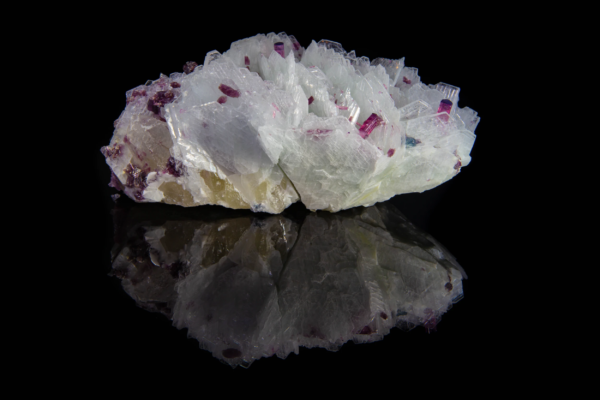
Lepidolite is the most common mineral that holds lithium, and a secondary source of that metal. It is also the main source of rubidium. Collectors look for its pink to purple masses and its stacked crystals, called books. Its pink color is often credited to lithium. In fact it comes from traces of manganese.
Geology & Occurrence
Formation
Lepidolite forms mostly in granite pegmatites, bodies of very coarse-grained granite. There it often replaces earlier muscovite or biotite. It also occurs in some granites, greisens, and quartz veins that formed at high temperature. It is found with spodumene, elbaite tourmaline, amblygonite, columbite, cassiterite, topaz, and beryl.
Notable Localities
The type locality is Rozna in the Czech Republic. Pala and Mesa Grande in California are well known, with lavender books from the Himalaya mine. It also comes from the Black Hills of South Dakota and the Tanco mine in Manitoba, Canada. Other sources are the Ural Mountains of Russia, Madagascar, and Minas Gerais in Brazil.
Lepidolite played a part in the discovery of a chemical element. In 1861 Robert Bunsen and Gustav Kirchhoff processed about 150 kg of lepidolite. From it they got only a few grams of rubidium salts. Studying those salts led them to find rubidium. The mineral is still the main source of that metal today.