Identity
Technical notes (click to open)(click to close)
Name & Human History
Etymology
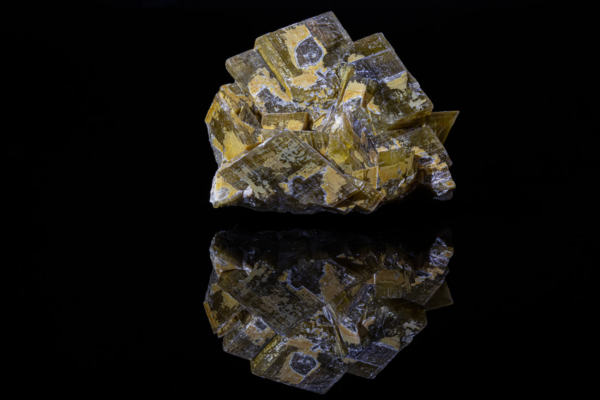
Siderite is an iron carbonate, a fairly heavy mineral in shades of yellow brown, tan, and gray. Its name comes from the Greek word for iron, which it holds in plenty. It often forms curved, saddle shaped crystals, much like its cousin dolomite, and also grows as rounded masses and earthy nodules. Where it gathers in quantity, it is a useful ore of iron.
Today
Siderite is both an iron ore and a collector's mineral. In bulk, beds of siderite have long been mined and smelted for iron. For collectors, the prize is sharp, glassy, honey brown crystals, often perched on quartz or sulfides. Their warm color and curved faces make handsome specimens, especially from a few classic mines.
Geology & Occurrence
Formation
Siderite forms in several ways. It grows in hot mineral veins alongside ores of silver and lead, and it settles in layers in muddy seas to form ironstone beds and nodules. It also forms in bogs. Over time, exposed to air, siderite slowly rusts at the surface into brown limonite.
Notable Localities
Siderite comes from many places. Fine crystals come from Cornwall in England, from the Harz mountains and Siegerland in Germany, and from Morocco. Portugal and Bolivia have produced superb gemmy crystals. Beds of siderite ironstone are common in coal regions, where they were once an important source of iron.
Siderite has traveled farther than almost any mineral, all the way from Mars. A famous meteorite from Mars, found in Antarctica, holds tiny globules of carbonate that include iron carbonate like siderite. In the 1990s some scientists thought these globules might hold traces of ancient Martian life. The claim is still debated, but it put this humble iron mineral at the heart of one of science's great questions.