Identity
Technical notes (click to open)(click to close)
Name & Human History
Etymology
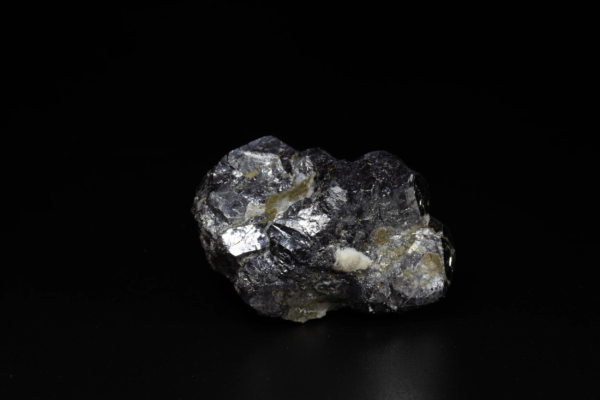
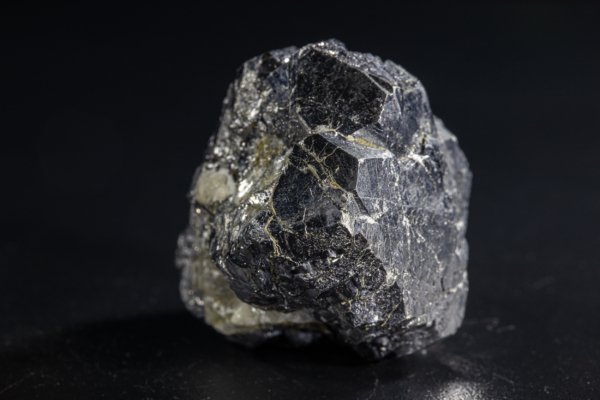
Skutterudite is a heavy, silvery metal mineral, a compound of cobalt and arsenic. It has a bright, tin white shine and often grows as cube shaped or eight sided crystals, much like pyrite. It is named after Skutterud, the place in Norway where it was first found. It is mined as an ore of cobalt and nickel, with arsenic as a by product.
Today
Skutterudite is valued as an ore and prized by collectors. Its bright silvery crystals stand out sharply against dark rock, and it often keeps company with silver and other rich ores. Because it holds arsenic, a specimen should be handled with care, and hands washed after touching it. Crushing or heating it gives off a sharp, garlic like smell.
Geology & Occurrence
Formation
Skutterudite forms in veins from warm to hot fluids. It grows in deposits rich in cobalt, nickel, and silver, alongside minerals like nickeline, silver, and the pink crust called erythrite. The crystals form where these metals gather in open veins. It is a classic mineral of the old silver and cobalt mining camps.
Notable Localities
Skutterudite comes from a handful of famous ore districts. The silver and cobalt mines of Cobalt, in Ontario, Canada, are a fine source. Its first home was Skutterud, in Norway, and superb crystals come from the cobalt deposits of Morocco. It is also found in Saxony, Germany, with the wider family of cobalt and nickel arsenides.
Skutterudite has a long history hidden in the color blue. For centuries the cobalt in ores like this was the source of smalt, a deep blue powder used to color glass and paint. Long before anyone knew the metal cobalt, that rich blue was prized by glassmakers and painters. So a dull silver rock quietly gave the world one of its finest blues. Its nickel rich twin, nickelskutterudite, is also held in this collection.