Identity
Technical notes (click to open)(click to close)
Name & Human History
Etymology
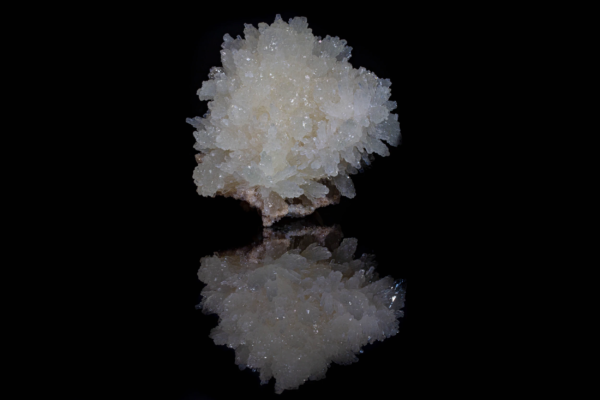
Strontianite is a carbonate of strontium, a pale, glassy mineral that forms slender prisms, needles, and radiating sprays, colorless to white, yellow, or faintly green. It is soft and surprisingly heavy. It was named for Strontian, a small village in the Scottish Highlands where it was first found, a place that would go on to name a chemical element as well.
Today
Strontianite is both a quiet industrial mineral and a collector's piece. It is a minor ore of strontium, the metal used to paint fireworks and flares a vivid red. For collectors, the appeal is its clean needle sprays and pseudohexagonal crystals, often sitting in cavities in limestone or in metal veins.
Geology & Occurrence
Formation
Strontianite forms at low temperature, in veins and cavities where strontium rich fluids move through rock. It grows in limestone and marl, in hydrothermal metal veins alongside minerals like celestine and barite, and in the carbonate rich igneous rocks called carbonatites. It belongs to the aragonite group, sharing its structure with that form of calcium carbonate.
Notable Localities
The type locality is Strontian in Argyll, Scotland. Fine specimens come from the Harz Mountains of Germany, from Austria, and from several sites in the United States, including Illinois, Pennsylvania, and South Dakota. It also occurs in Mexico and in the carbonatite massifs of the Kola Peninsula in Russia.
A tiny Scottish village named an element. Strontianite was found in the lead mines near Strontian in the 1790s, and chemists soon realized it held a metal no one had named. They called it strontium, after the village, and in 1808 Humphry Davy isolated it. Strontian is one of the very few places on Earth with a chemical element named for it, its name now printed on the periodic table.