Identity
Technical notes (click to open)(click to close)
Name & Human History
Etymology
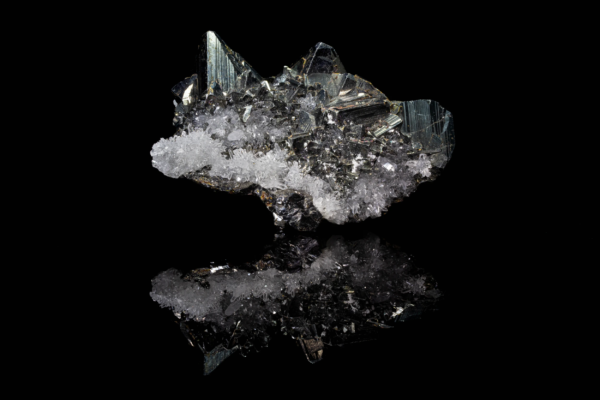
Tetrahedrite is a gray metal mineral, a sulfide of copper and antimony. Its name comes from the shape of its crystals, which are tetrahedrons, little four faced pyramids. It is flint gray to iron black with a metallic shine. The full name, tetrahedrite-(Fe), marks the iron rich member of a whole family of closely related minerals.
Today
Tetrahedrite is an important ore and a collector's favorite. It can carry a lot of silver hidden in its structure, and for centuries it was a valued silver ore as well as a copper one. For collectors, sharp gray tetrahedrons are the prize. Their clean, pyramid like shape is unusual and easy to spot among the duller masses of other ores.
Geology & Occurrence
Formation
Tetrahedrite forms in veins deposited by hot fluids. It grows alongside other sulfides, such as chalcopyrite, sphalerite, and galena, in deposits rich in copper, silver, lead, and zinc. The crystals form where these metals gather in open veins, often in the same places that yield silver.
Notable Localities
Tetrahedrite comes from ore districts around the world. Fine sharp crystals come from the silver mines of Peru and from Romania. The old silver district of Freiberg, in Germany, is a classic source. Good tetrahedrite also comes from Bolivia, Mexico, and the western United States.
Tetrahedrite is really the head of a large family. Once treated as a single mineral, it was found to come in many forms, each with a different metal woven in. So the name now works as a family label, and a tag in brackets marks the exact kind. This one, tetrahedrite-(Fe), is the iron rich member, named under the modern rules that sorted the whole group out.