Identity
Technical notes (click to open)(click to close)
Name & Human History
Etymology
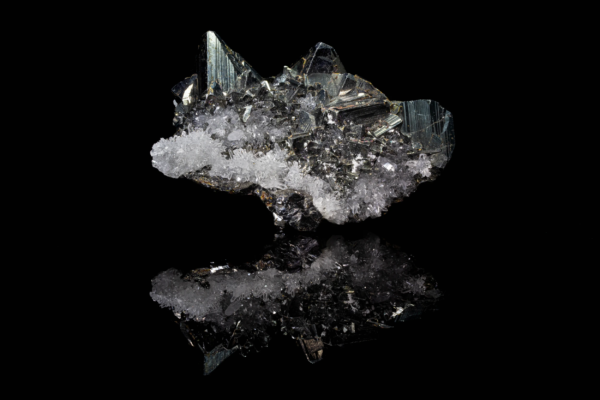
Tetrahedrite is a gray metal mineral, a sulfide of copper and antimony. Its name comes from the shape of its crystals, which are tetrahedrons, little four faced pyramids. It is steel gray to iron black with a metallic shine. Today the name covers a whole family of closely related minerals. Each member carries a small amount of a different metal, most often iron or zinc.
Today
Tetrahedrite is an important ore and a collector's favorite. It can carry a lot of silver hidden in its structure, and for centuries it was a valued silver ore as well as a copper one. For collectors, sharp gray tetrahedrons are the prize. Their clean, pyramid like shape is unusual and easy to spot among the duller masses of other ores.
Geology & Occurrence
Formation
Tetrahedrite forms in veins deposited by hot fluids. It grows alongside other sulfides, such as chalcopyrite, sphalerite, and galena, in deposits rich in copper, silver, lead, and zinc. The crystals form where these metals gather in open veins, often in the same places that yield silver.
Notable Localities
Tetrahedrite comes from ore districts around the world. Fine sharp crystals come from the silver mines of Peru, such as Casapalca, and from Romania. The old silver district of Freiberg, in Germany, is a classic source. Good tetrahedrite also comes from Bolivia, Mexico, and the western United States.
Tetrahedrite is really the head of a large family. For a long time it was treated as a single mineral. Then scientists found that the metal sitting at one spot in its structure changes from place to place: iron, zinc, mercury, cadmium, and others. Since the 2020 update of the naming rules, each version has its own name, with the key metal in brackets, such as tetrahedrite-(Zn). Telling them apart takes a lab analysis, so most collection pieces are simply labeled tetrahedrite.