Identity
Technical notes (click to open)(click to close)
Name & Human History
Etymology
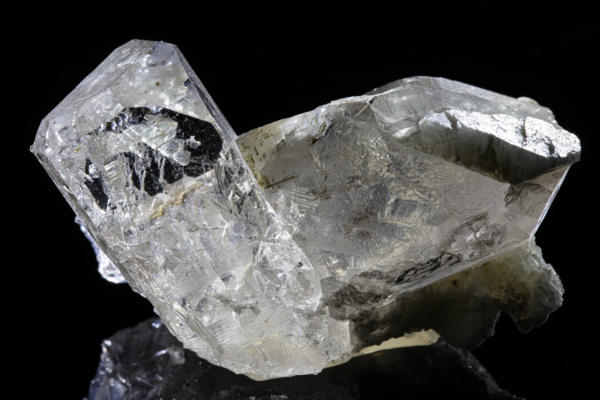
Topaz is a hard, glassy silicate, often clear or a warm golden color. It is best known for two things, its great hardness and its beauty as a gem. Pure topaz is colorless, but traces of other elements and natural flaws tint it yellow, blue, pink, or a prized golden orange. It forms in long, glassy crystals with flat, striated faces.
Through the Ages
Topaz has been a treasured gem since ancient times. Its clear, durable crystals were carved and faceted long ago, and the golden orange kind, called Imperial topaz, has always been the most prized. In huge crystals it is famous too, since pegmatites have yielded flawless topaz crystals weighing hundreds of pounds.
Today
Topaz is a popular gem today and the birthstone of November. Natural colors include yellow, sherry, pink, and a rare golden orange. Most of the deep blue topaz in jewelry began as colorless stone, then was treated to bring out the blue. Because topaz is so hard, it wears well, though its perfect cleavage means a sharp knock can split it.
Geology & Occurrence
Formation
Topaz forms late, as a hot granite magma cools. It needs the element fluorine, which gathers in the last fluids of a cooling granite, so it grows in coarse veins called pegmatites and in the cavities of certain volcanic rocks. It often shares these pockets with quartz, fluorite, and tourmaline.
Notable Localities
Topaz is found around the world. The prized Imperial topaz comes from Ouro Preto in Brazil. Fine crystals also come from Russia, Pakistan, and Myanmar. Clear and sherry colored topaz fills cavities at Topaz Mountain in Utah, and giant crystals have come from the pegmatites of Brazil and Ukraine.
Topaz set the standard for hardness. Two hundred years ago a scientist named Friedrich Mohs built a scale to rank minerals by how easily they scratch. He chose ten common minerals to mark the steps, and topaz he set at number eight, near the very top. That scale is still used the world over, so every student of rocks meets topaz as the measure of a very hard stone.