Identity
Technical notes (click to open)(click to close)
Name & Human History
Etymology
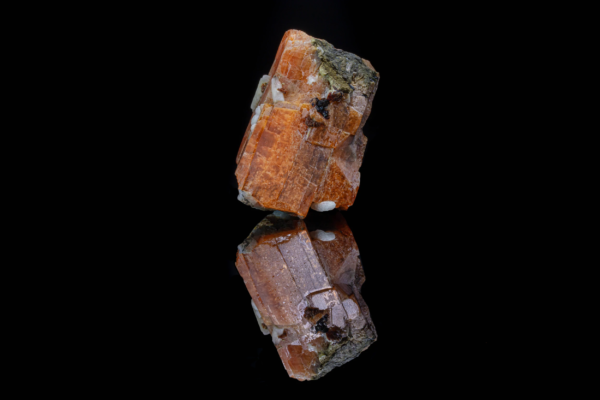
Analcime is a glassy sodium aluminum silicate that often grows as round, many-faced crystals. They are usually white or colorless, sometimes pink, gray, or greenish. The name comes from a Greek word meaning weak. It refers to the weak electric charge the mineral picks up when it is heated or rubbed. The French scientist Rene Just Hauy gave it this name in 1797. Before that, Deodat de Dolomieu had described it from lava of the Cyclopean Islands near Sicily.
Today
Analcime has no real practical use. Collectors look for it because its crystals can be sharp, clean, and large. Their shape looks like a small faceted ball. It is rarely made into jewelry. Some rocks rich in analcime, formed from volcanic ash, are used as building stone.
Geology & Occurrence
Formation
Analcime forms in the gas bubbles and cracks of basalt and other dark volcanic rocks. Analcime grows there with zeolites, prehnite, calcite, and quartz. It also forms in old lake beds and in sandstones, at temperatures below about 100 C.
Notable Localities
Mont Saint-Hilaire in Quebec, Canada, has produced crystals up to 25 cm across, found with serandite and aegirine. Val di Fassa in northern Italy gives pinkish white crystals over 10 cm. The Cyclopean Islands off Sicily are where it was first described. It also comes from Cape Blomidon in Nova Scotia, Iceland, and Siberia, where white crystals reach 18 cm.
Analcime looks cubic, but it usually is not quite. Careful study shows that most crystals are slightly off from true cubic symmetry, by just a fraction of an angle. Different samples have been measured as tetragonal, orthorhombic, monoclinic, or even triclinic, with tetragonal the most common result. The cause is small differences in how silicon and aluminum atoms are arranged in the framework. The basic framework stays the same in all of them.