Identity
Technical notes (click to open)(click to close)
Name & Human History
Etymology
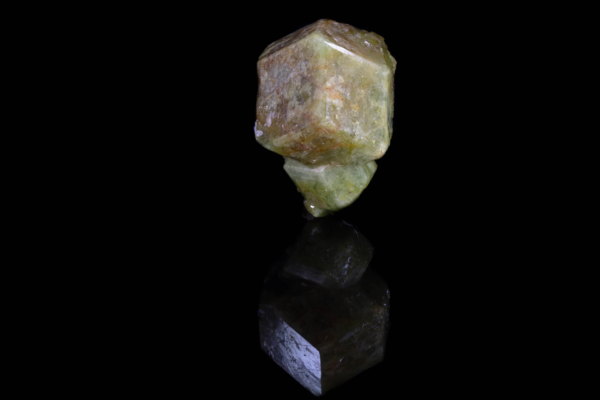
Andradite is the calcium and iron member of the garnet family. Its crystals are often brown, yellow, green, or black, with a bright, almost diamond like shine. It is named for Jose Bonifacio de Andrada e Silva. He was a Brazilian scientist and statesman who described one of its varieties. The mineral was first described under this name in 1868, from Drammen in Norway.
Today
Andradite is best known for its green gem variety, demantoid. Demantoid is one of the most valuable garnets, and good stones are rare. A yellow green variety called topazolite is sometimes cut too, and is rarer still. The black variety, melanite, gets its color from titanium.
Geology & Occurrence
Formation
Andradite forms mostly in skarns. These are rocks made when hot magma meets impure limestone and changes it. There it grows with vesuvianite, epidote, calcite, and magnetite. It also forms in serpentinite and chlorite schist. The black kind, rich in titanium, forms in some alkaline igneous rocks.
Notable Localities
Demantoid was first found along the Bobrovka River in the Ural Mountains of Russia. Val Malenco in Italy, Namibia, Madagascar, and Iran also produce demantoid. Crystals also come from Stanley Butte in Arizona and the Wessels mine in South Africa. Other listed localities include the Alban Hills near Rome and Magnet Cove in Arkansas.
Demantoid was found in 1851 in a gravel deposit along the Bobrovka River in the Russian Urals. The name comes from an old German word for diamond, Demant. Demantoid spreads light into colors more strongly than diamond does, which gives it visible fire. The jeweler Carl Faberge used it in his pieces, and it stayed popular in Russia until about 1919.
Many Russian demantoids hold a small flaw that gem experts welcome. Fine golden threads of chrysotile, a fibrous mineral, fan out from a tiny chromite crystal inside the gem. These are called horsetail inclusions. They are taken as a sign that a demantoid is natural. They often point to a Russian origin, though some Italian and Iranian stones show them too.