Identity
Technical notes (click to open)(click to close)
Name & Human History
Etymology
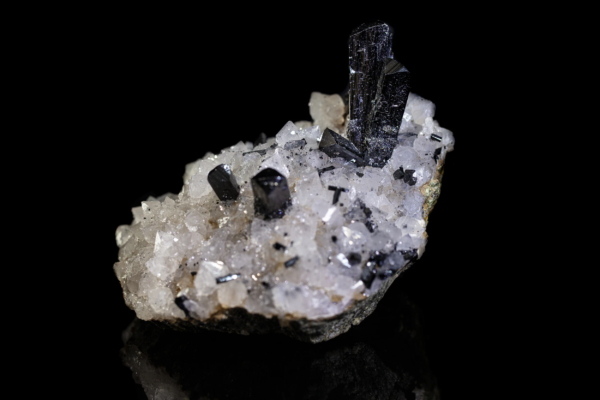
Ilvaite is a heavy black mineral, a silicate of iron and calcium. It grows as glossy black prisms with deep lengthwise grooves, and it has a dark, almost metallic shine. It was first found on the Italian island of Elba and named in 1811 from Ilva, the old Latin name for that island. At first it was mistaken for black tourmaline, which it can resemble.
Today
Ilvaite is mostly a collector's mineral, though it has served as a minor ore of iron. Its appeal is its bold, dark, architectural look. Sharp black prisms stand out on a pale bed of quartz or calcite, often beside green or brown garnet. It is not a flashy mineral, but a fine group has a strong, brooding presence that collectors enjoy.
Geology & Occurrence
Formation
Ilvaite forms in skarns. A skarn is the zone where hot magma meets limestone or dolomite and reshapes it. Iron rich fluids moving through that zone build ilvaite, often alongside hedenbergite, garnet, and quartz. It is a sure sign of an iron rich skarn, and the best crystals grew in cavities within such rocks.
Notable Localities
Ilvaite comes from a handful of classic places. Elba in Italy is the original home. The Greek island of Serifos has produced large crystals, some in radiating groups reaching great size. The mines of Dal'negorsk in eastern Russia yield the sharpest, glossiest crystals. Fine ilvaite also comes from Idaho and from China.
Ilvaite holds a small puzzle in its chemistry. It carries iron in two different charge states at once, a more oxidized form and a less oxidized one. Inside the crystal, electrons can hop between these iron atoms, so the two states keep trading places. This restless mix of iron is what gives ilvaite its deep black color and draws the interest of scientists.