Identity
Technical notes (click to open)(click to close)
Name & Human History
Etymology
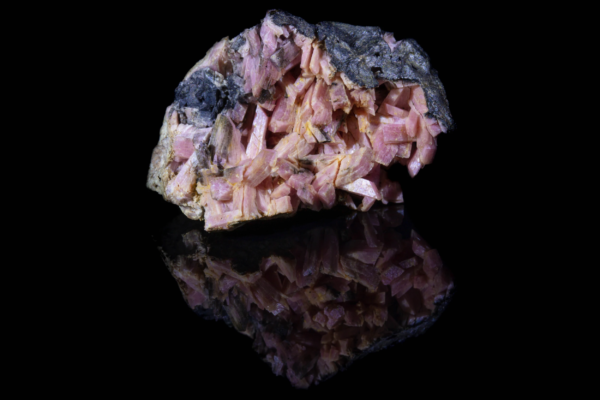
Inesite is a rare silicate of calcium and manganese, and it is known above all for one thing: color. It grows in sprays of slender pink to flesh red blades, sometimes gathered into rounded bursts. The name comes from the Greek word for flesh fibers, chosen in 1887 for the fibrous habit and the meaty pink of the first specimens.
Today
Inesite has no industrial use. It exists in collections and nowhere else, wanted for a warm pink that few minerals reach. The finest sprays sit on dark manganese ore, and the contrast is the whole point. Good pieces are scarce, because the mines that produced them are few and most are closed.
Geology & Occurrence
Formation
Inesite forms in manganese deposits, where hot water moves through the ore late in its history. Calcium and manganese come together with silica in open cracks and cavities, and the mineral grows there as blades and needles. It keeps company with minerals of the same setting, such as rhodochrosite, apophyllite, xonotlite, and quartz.
Notable Localities
The type locality is Nanzenbach in Germany, but the great inesite comes from South Africa, from the Wessels and N'Chwaning mines in the Kalahari manganese field, where pink sprays sit on black ore. Hale Creek in Trinity County, California, has yielded sharp prisms. Other sources include Broken Hill in Australia, Hubei in China, Japan, and Sweden.
Inesite has a quiet problem: its pink does not last. Left in the light, the surface slowly clouds and browns as a thin film of manganese oxide forms on it. The change is not dramatic from one day to the next, which is exactly the trouble. A specimen bought bright and set on a sunny shelf may take years to go dull, and by then nothing brings the color back.