Identity
Technical notes (click to open)(click to close)
Name & Human History
Etymology
Natrolite is a sodium aluminum silicate with water, a member of the zeolite family. It most often grows as slender white or clear needles, in sprays and tufts. These earned it the nickname needle stone. Martin Heinrich Klaproth named it in 1803. The name joins natron, the old word for soda, with lithos, Greek for stone, because the mineral is rich in sodium. Its type locality is Hohentwiel in the Hegau region of Germany.
Today
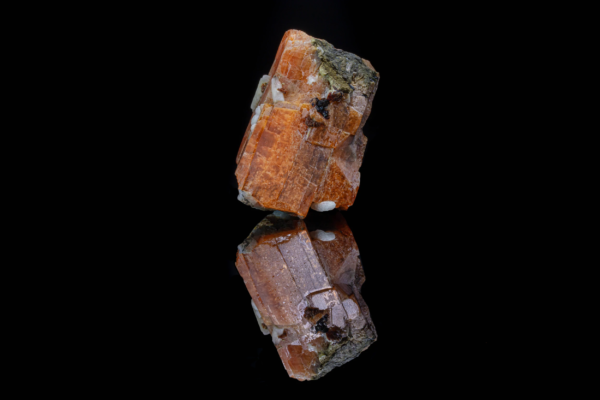
Natrolite is mainly a collector's mineral. People look for its bright sprays of needles in basalt pockets, and for the large prisms from the Kola Peninsula and Mont Saint-Hilaire. Many specimens glow yellow or orange under ultraviolet light. In San Benito County, California, it forms the white veins that hold benitoite and neptunite.
Geology & Occurrence
Formation
Natrolite usually forms in the gas bubbles of basalt and related volcanic rocks. It is often one of the last minerals to grow there, from warm water moving through the rock. It is also common in nepheline syenites. It fills cracks in granite, gneiss, and syenite too. It grows with other zeolites, calcite, quartz, nepheline, and sodalite.
Notable Localities
The type locality is Hohentwiel, Germany. The Khibiny and Lovozero massifs on the Kola Peninsula, Russia, give large crystals. Mont Saint-Hilaire in Quebec, Canada, has produced large crystals with many rare minerals. Fine sprays come from Puy de Marman in France and from Bound Brook and Prospect Park in New Jersey, USA. It is also found at the Gem mine in San Benito County, California.
Natrolite gives itself away in a simple old test. A small piece melts easily in a candle flame, and the flame turns yellow from its sodium. Hydrochloric acid breaks it down and leaves a jelly of silica. The crystals are also pyroelectric and piezoelectric. This means they build up an electric charge when heated or squeezed.
Natrolite crystals look square, like a mineral of the tetragonal system, but they are not. Their prism angle is only very close to a right angle, and the true symmetry is orthorhombic. On the Kola Peninsula, these crystals can reach 30 cm long.