Identity
Technical notes (click to open)(click to close)
Name & Human History
Etymology
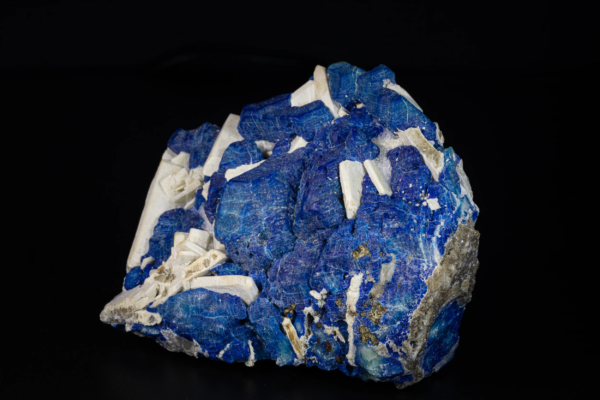
Sodalite is a rich royal blue mineral, often laced with white veins. It is a silicate built around sodium, and its name simply points to that sodium content. It is usually seen as solid blue masses rather than crystals, and the best of it is a deep, even blue. Cut and polished, it is a popular ornamental stone for carvings and beads.
Today
Sodalite is valued as a blue gem and decorative stone. Its even royal blue, marked with white, is carved into bowls, beads, and inlays, and cut into slabs for tabletops. It is sometimes called the poor man's lapis, since it looks like the costlier lapis lazuli but lacks the golden flecks of pyrite that lapis usually shows.
Geology & Occurrence
Formation
Sodalite forms from magmas that are poor in silica, the same unusual setting that makes its cousin nepheline. Where a magma runs short of silica, ordinary feldspar cannot fully form, and minerals like sodalite grow instead. It is found in rare alkaline rocks, and almost never shares a rock with quartz.
Notable Localities
Sodalite comes from a scattering of alkaline rock bodies. Brazil is a major source of the rich blue ornamental stone. Fine crystals and masses come from Bancroft in Ontario, Mont Saint Hilaire in Quebec, and Ilimaussaq in Greenland, where it was first found. It also occurs in Russia, Namibia, and Afghanistan.
Sodalite has a hidden cousin that performs a magic trick. A pale variety called hackmanite changes color in the light. Freshly dug, it can be a soft violet, but in sunlight the color fades to gray. Put back in the dark, it slowly turns violet again. This strange, reversible color change delights collectors, who keep their hackmanite away from the sun to preserve the show.