Identity
Technical notes (click to open)(click to close)
Name & Human History
Etymology
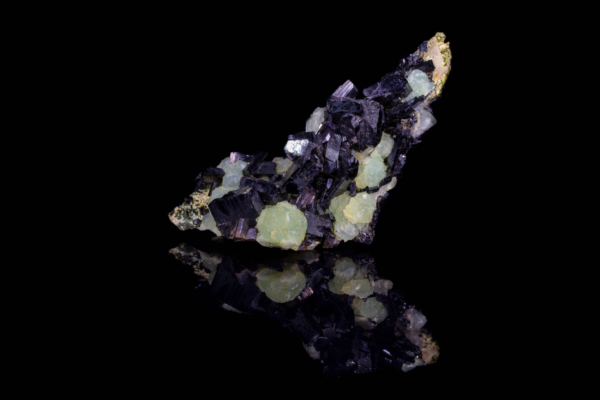
Babingtonite is a dark green to black silicate of calcium and iron. It forms short crystals with fine grooves and a glassy shine, often in clusters or crusts of small crystals. It was first described in 1824. It is named after William Babington, an Irish doctor and mineralogist. Its type locality is Arendal in southern Norway.
Today
Babingtonite is a collector's mineral with no industrial use. It is the official mineral of the Commonwealth of Massachusetts. Collectors look for its jet black, glassy crystals. These often sit with prehnite or zeolites in volcanic cavities. Crystals reach about 3 cm.
Geology & Occurrence
Formation
Babingtonite grows in cavities in volcanic rocks such as basalt. There it forms with zeolites, prehnite, and calcite. It also occurs in veins that cut granite pegmatite and diorite, in gneiss, and in skarns. Epidote, albite, garnet, hornblende, and quartz are other common companions.
Notable Localities
Its type locality is near Arendal in Norway. In the USA, Lane's quarry in Massachusetts is known for jet black crystals. Crystals with prehnite come from Qiaojia in Yunnan, China. It is also found at the Khandivali quarry near Mumbai, India, and at Baveno in Italy.
Babingtonite is an odd silicate. In most silicates, aluminum takes a key place in the structure. Here, iron in its oxidized form replaces the aluminum completely. The mineral also holds iron in two states at once, ferrous and ferric. Because of this iron, babingtonite shows a weak magnetism.