Identity
Technical notes (click to open)(click to close)
Name & Human History
Etymology
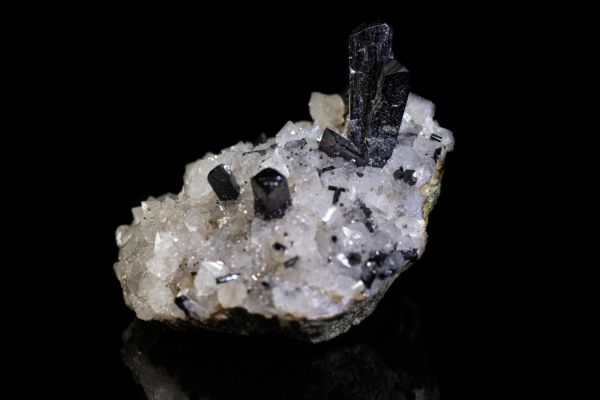
Hedenbergite is a dark green to black pyroxene, a silicate of calcium and iron. It is the iron rich partner of diopside, which holds magnesium in place of iron. Jons Jakob Berzelius named it in 1819 for Anders Ludvig Hedenberg (1781-1809). Hedenberg was a Swedish chemistry student who worked with Berzelius. He first found and described the mineral at the Mormor mine at Tunaberg in Sweden.
Geology & Occurrence
Formation
Hedenbergite is common in skarns rich in iron and manganese. These rocks form where hot fluids from magma react with limestone. It also forms in iron formations changed by heat and pressure, and in some granites and syenites. It is often found with quartz, andradite, ilvaite, calcite, and hematite.
Notable Localities
The mineral was first found at Tunaberg in Sweden. The Nickel Plate gold skarn at Hedley in British Columbia, Canada, is rich in it. Fine crystals come from the Laxey mine in Idaho, United States, and from the Skardu area of Pakistan. It is also found on Elba in Italy, at Broken Hill in Australia, and at Huanggang in Inner Mongolia, China.
Hedenbergite has turned up in a meteorite. In the Allende meteorite, it is the most common calcium rich silicate among the minerals that formed later inside its small round grains, called chondrules. There it is closely tied to two other minerals, sodalite and nepheline. So the mineral first found in a Swedish mine also formed in a rock from space.